Blog
Tchaikovsky’s First Symphony: A Flute Player’s Perspective
Lydia Roth reflects on the great composer’s “Winter Dreams.”

The first album I remember purchasing with my own money was a collection of all six Tchaikovsky symphonies. Growing up, our home was full of classical music—the sounds of my siblings practicing, our local classical radio station playing in the car around town, my mom putting on a favorite cassette or CD while cooking—and though we all loved the music of Tchaikovsky, somehow the symphonies were missing among our family’s collection. Already an aspiring orchestral flutist, I had dutifully studied excerpts from the Fourth Symphony (the swirling flute solo in the fourth movement is still a thrill, and who can forget the wild frenzy of the piccolo in the third movement?), and from my reading I knew that all three of the later symphonies were not to be missed. But as Julie Andrews tells us in The Sound of Music, “Let’s start at the very beginning,” and so I did. Little did I expect how enamored I would be right away with the very first symphony and its evocative subtitle of “Winter Dreams.”
My own relationship with Tchaikovsky’s music has had its ups and downs. As a young student, Tchaikovsky was to me like a musical god—I remember I chose him as the topic of my first assigned research paper in middle school, and when I would try my hand at composing myself, my efforts were heavily inspired by his style. Once I began to encounter his works in the orchestra, however, I found myself disenchanted. Tchaikovsky writes for the woodwind section like no other composer I know of: his music is full of these densely scored unisons, two or three flutes all playing together, often with a piccolo maddeningly in the same octave instead of soaring above, and often together with clarinets, oboes, or even bassoons in octaves. Where other composers might run a melody in thirds or sixths, or spin out a countermelody (or even just write a solo and give everyone else a rest!), with Tchaikovsky it always seems to be these strange unisons. It’s difficult—the blending, the intonation, the phrasing together—and especially as a young player, naively eager to show off my own solo sound, I found Tchaikovsky’s woodwind writing ungratifying and, in a way, deeply insulting.
“The First Symphony still enthralls me every bit as it did when I first heard it years ago. . . . As you listen to this rarely heard symphony, I hope that you, too, will find yourself enchanted.”
With time, though, I’ve learned to appreciate what he was seeking in his orchestration—not the brightness of a solo instrument, but something duller, darker, a totally unique color other composers rarely choose to explore. That low-range piccolo blending with the flute section wasn’t a misunderstanding on his part; it cuts out some of the brilliance of the high flutes, and the flutes in turn help to project the dusky tone of the low piccolo. Certainly, the tone colors one might use to play, say, Brahms or Beethoven or Ravel don’t work in this music. But if all composers sounded the same, where would be the fun in that? I’m proud to live in a world full of diversity, and I take great pride in finding and bringing to life the unique sounds each composer brings to the orchestra. To play Tchaikovsky as a woodwind player, I’ve found there’s a necessary setting aside of one’s ego, of one’s personal expression of the sound, in deference to a collective melding to create a one-of-a-kind color palette. It takes maturity to explore (and it helps to have great colleagues, too!), and I’m happy to have once again found my childhood love of a favorite composer rekindled.
The First Symphony still enthralls me every bit as it did when I first heard it years ago. Though an early work, there’s something quintessentially Tchaikovsky in it—in the melodies themselves, but also already the seeds of a composer experimenting with the possibilities of orchestration—plus, the imagery he evokes with the subtitles, both of the symphony as a whole and of the first two movements (respectively, “Dreams of a Winter Journey” and “Land of Desolation, Land of Mists”), provide rich food for the imagination.
As you listen to this rarely heard symphony, I hope that you, too, will find yourself enchanted. Listen for his unique woodwind writing—the opening theme, folksy and fragmented, introduced by the unlikely pairing of solo flute and bassoon, the second theme played first by the clarinet but later in the movement reprised by the two flutes and two clarinets together. Picture the landscape as these threads are passed through so many different instruments of the orchestra. Listen in the second movement for the snowy muted strings, the singing oboe solo, the flute’s flourishes that always remind me of a blustery winter wind. Be carried away by the whirling lightness of the scherzo, and of course the bright heroism of the G major finale.
Tchaikovsky’s First Symphony first opened my eyes to the magic of his symphonic writing all those years ago. Like so much of classical music, this work has the power to transcend time, transfixing audiences for generations to come. I hope that during this weekend’s performances, I will look out and see that same look of wonder in the faces of the audience.
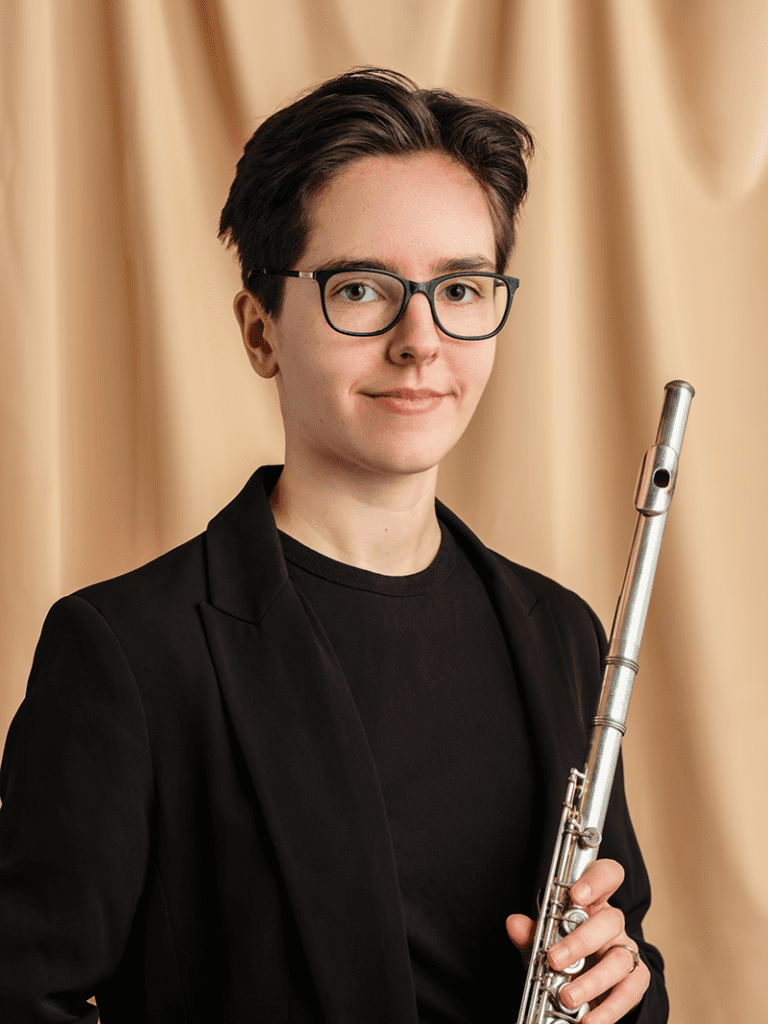
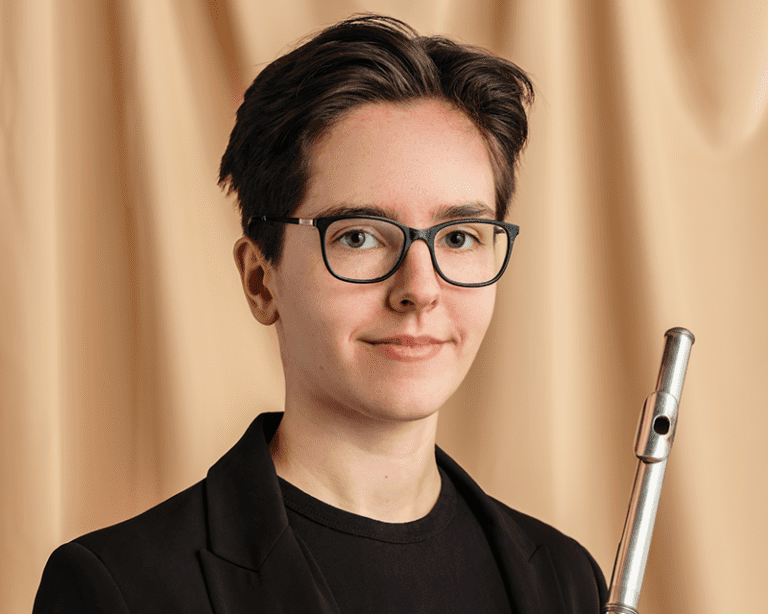
Lydia Roth joined the Columbus Symphony in 2021. A native of Grand Rapids, Michigan, she grew up in a musical home playing flute, oboe, and piano, as well as studying composition. When she’s not performing, you can find Lydia drinking a mug of tea while reading a book or solving a crossword puzzle. She lives with her wife and their two cats.